Related

Thursday Thoughts for June 18th
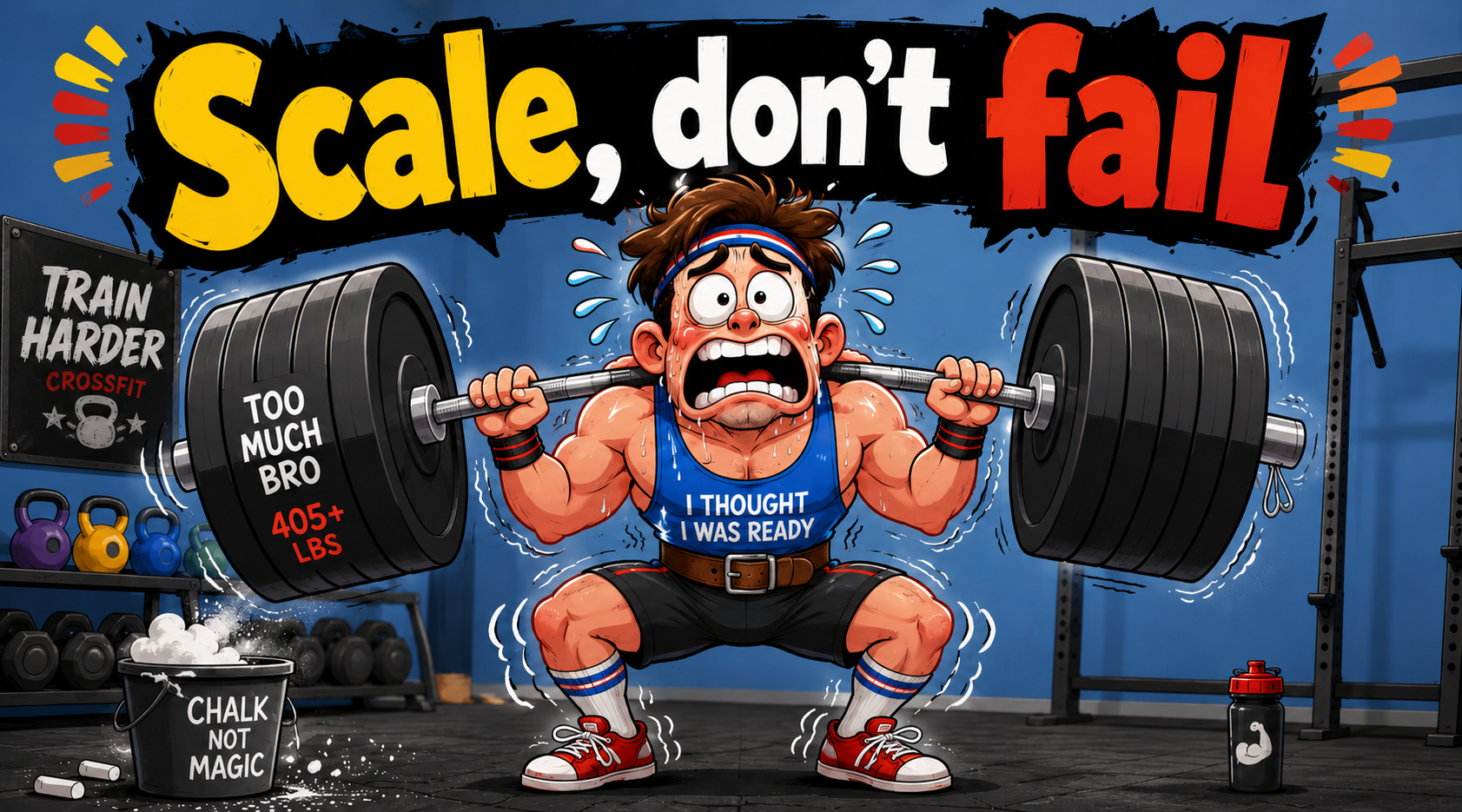
Scale Don’t Fail
There are a lot of new faces around the gym and it never hurts to review the basics so I will be writing a few informative posts from time to time. Who knows, maybe someday I will be fitness influencer. Big dreams.
Helping you scale is one of the reasons we have coaches here. If you are still unsure about scaling or the stimulus of the workout after the whiteboard chat, just ask. We are happy to help.
PRVN programming is tough. Really tough. In 15 years of CrossFit it's the toughest RX I have ever seen and I have seen a lot of programming.
This week has been especially tough, so it feels like a good time to talk about scaling workouts.
First, scaling is not failing. Scaling is training smart.
One of the things I like about our PRVN programming is that Level 2 is most gyms RX. I think that is a great thing. It sets a real standard and takes away the idea that everyone should be chasing RX every single day. It reminds me of the old school days of CrossFit.
RX is not the goal every day.
The goal is to get the right workout for you.
Yesterday’s workout took a lot of people by surprise, including me. That happens. Sometimes you start a workout and realize pretty quickly that you missed the mark. I did even after a great whiteboard briefing by Coach Melody. She told us several things including every round was sprint, I knew I should scaled more but I didn't until mid workout.
Maybe the weight is too heavy. Maybe the gymnastics movement is slowing you down more than expected. Maybe the workout is supposed to be fast and you are staring at the bar every rep.
That is okay.
It is absolutely okay to scale mid-workout if you know you're way off.
Scaling exists so you can hit the intended stimulus of the workout. That means you are getting the right dose of intensity, skill, strength, and conditioning for that day.
Every workout has a purpose.
Some workouts are supposed to be heavy and grindy. Some are supposed to be fast. Some are supposed to make you wonder if you ever did CrossFit before. Some are designed so you can move through big sets with short breaks. Some are meant to challenge a specific skill.
Your job is not always to do the hardest version possible.
Your job is to pick the version that lets you get the best training effect. Our job is to help you with that.
A good example is a workout that says a certain number of rounds for time with a time cap. That time cap is not random. It is a guide.
If the workout has a 15-minute time cap, the goal is not to get capped every time because you picked the hardest version. The goal is to finish under the time cap, or at least be very close. Is it ok to go over the cap once in awhile? Sure it is, but that should not happen too often.
If it's not a workout for time, an AMRAP, we will give you a number of rounds to shoot for.
Before the workout starts, ask yourself:
“What do I need to do to finish this workout under the time cap or get the suggested amount of rounds in?"
That may mean lowering the weight. It may mean changing the gymnastics movement. It may mean reducing reps. It may mean choosing Level 2 or 1 instead of RX.
That is not a step backward.
That is how you get better.
If a workout is written in a way where the barbell should be touch-and-go or cycled quickly, then the weight should not be anywhere near an upper percentage of your one-rep max. If you are doing singles from the start on a workout that is supposed to be fast, you probably missed the point of the workout.
That does not mean you are weak.
It means the weight was wrong for that day.
Good scaling keeps you moving. Good scaling helps you train the intended stimulus. Good scaling lets you improve without turning every workout into a survival test.
We want you working hard. We want you challenged. We want you uncomfortable.
But we also want you getting better.
That is the difference between just suffering through a workout and actually training.
So next time you look at the board, do not just ask, “Can I do RX?”
Ask a better question:
“What version of this workout will make me better today?”
Scale don’t fail.